How to Read Your Dog's Body Language: Guide
Your Dog Is Talking — Are You Listening?
Dogs don’t use words, but they communicate constantly. Every ear twitch, tail position, body tension, or glance can be an important signal. Dog body language is a language truly worth learning.
Understanding dog communication helps prevent misunderstandings, build a deeper bond, notice stress earlier, and respond before emotions turn into fear, frustration, or aggression.
The most important rule is: never interpret a single signal without context. A dog with a lowered tail may be scared, but in some breeds it may simply be their natural posture. Always look at the whole picture: tail, ears, eyes, mouth, muscle tension, movement, and context.
Below is a practical guide to the most important signals your dog sends every day.
Signal Anatomy — What to Observe?
A dog’s body works as an integrated communication system. One signal rarely tells the full story, but several signals together can clearly show what the dog is feeling.
Tail
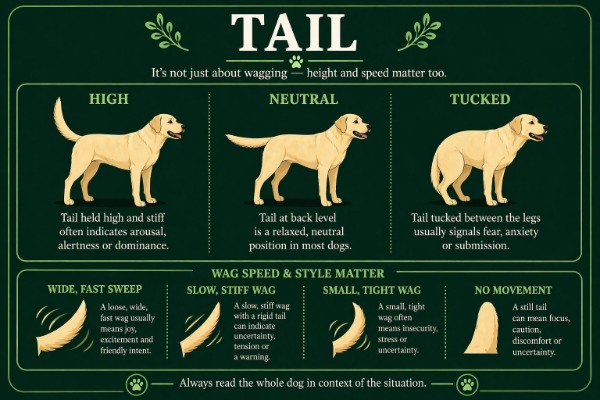
The tail is not just about wagging. Height, tension, and movement speed matter. A high and stiff tail may indicate arousal, alertness, or tension. A tail held low or tucked between the legs often signals fear or insecurity. Loose, wide wagging usually means happiness, while slow and tense movements can suggest caution.
Ears
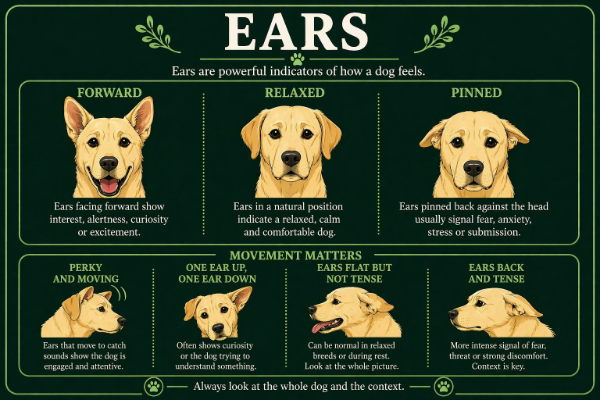
Ears facing forward can indicate interest, focus, or tension. Ears pinned back or tightly against the head often appear with fear, submission, stress, or pain. In dogs with floppy ears, signals may be less visible, so it’s important to observe the eyes, mouth, and body posture as well.
Eyes
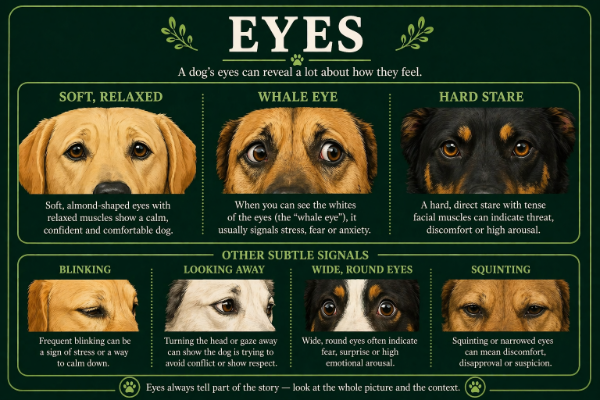
Soft, slightly squinted eyes usually indicate calmness and relaxation. Wide eyes with visible whites, often called “whale eye”, may signal discomfort or anxiety. A hard, fixed stare can be a warning sign. Blinking, looking away, or glancing sideways helps the dog reduce tension.
Body Posture
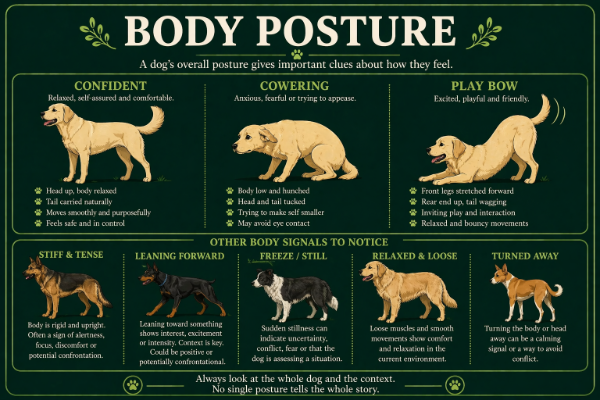
A tense, stiff body with weight shifted forward may indicate arousal, readiness to act, or a potential threat. A crouched or backward-leaning posture often signals fear and a need for distance. A dog lying on its back with an exposed belly doesn’t always ask for petting — it can also be a request to stop interaction.
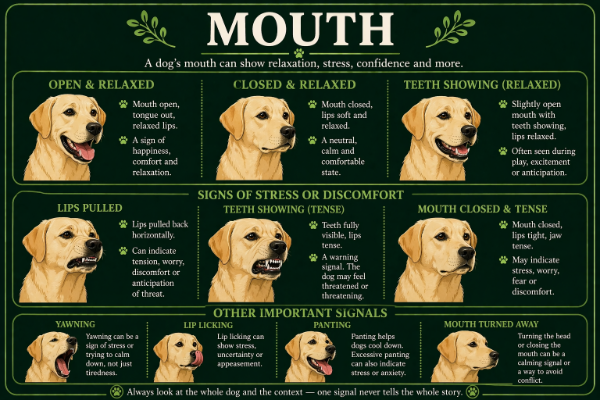
Mouth and Breathing
A loosely open mouth and calm breathing often indicate comfort. A closed mouth, lip licking, yawning out of context, or panting without physical exertion may be signs of stress. A wrinkled muzzle and exposed teeth are serious warning signals that should never be ignored.
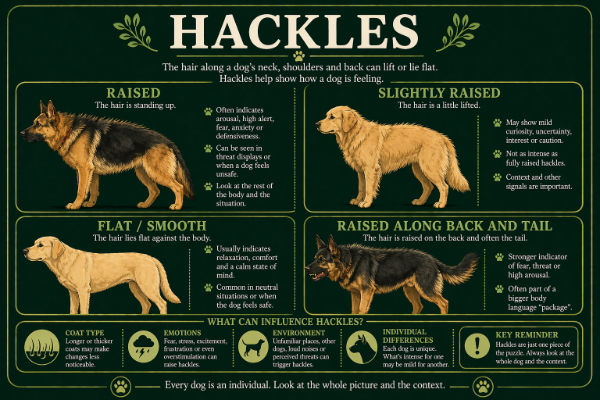
Coat
Raised fur along the back is an involuntary reaction, similar to goosebumps in humans. It may appear during fear, excitement, uncertainty, arousal, or aggression. On its own, it doesn’t automatically mean aggression — it must always be interpreted in context with the rest of the body.
Dog Emotional States
The examples below help you recognize whether a dog is calm, happy, stressed, fearful, excited, or ready to defend itself. Remember, emotions are best assessed by looking at a combination of signals.
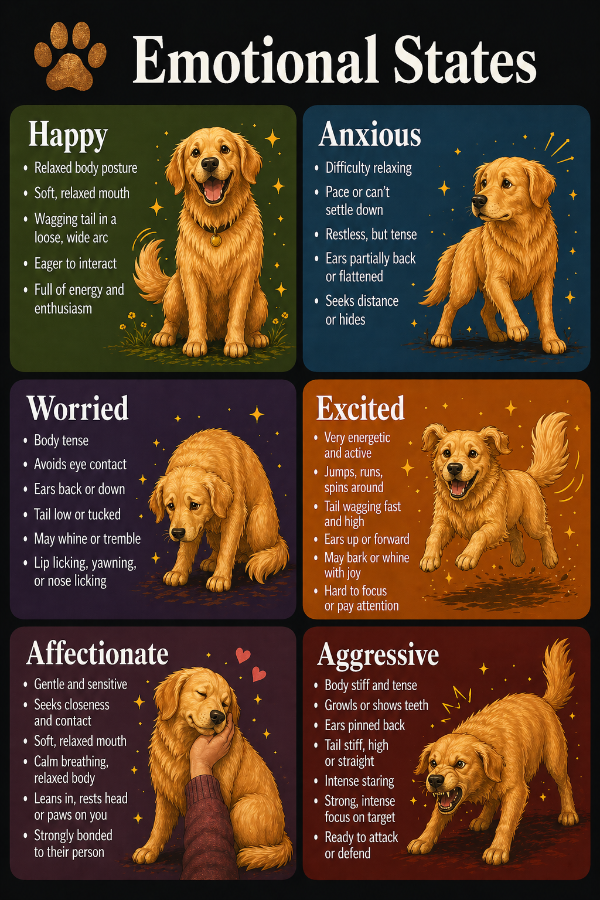
Happy
Relaxed body posture, soft facial expression, loose wide tail wagging, seeks interaction, full of energy and enthusiasm.
Anxious
Difficulty calming down, pacing or unable to stay still, tail moving but tense, ears partially raised or pulled back, alert and sensitive to surroundings.
Worried
Tense body posture, avoids eye contact, ears pulled back, tail low or tucked, may hide or stay close to the handler, wrinkled forehead, closed mouth.
Excited
Very energetic and active, jumping, running, spinning, fast high tail wagging, ears up, may whine with excitement, difficulty focusing.
Affectionate
Gentle and sensitive, seeks closeness and contact, soft expression, calm breathing, relaxed body, leans, cuddles or stays close, strongly attached to the handler.
Aggressive
Tense, stiff body, growling or showing teeth, ears back or rigid, tail stiff and raised, intense staring, ready to attack or defend.
❗Do Not Ignore Growling
Growling is communication, not misbehavior. A dog that growls is giving you a chance to back off without escalation. Punishing growling can teach the dog to skip the warning and move straight to biting.
Calming Signals — The Language of Peace
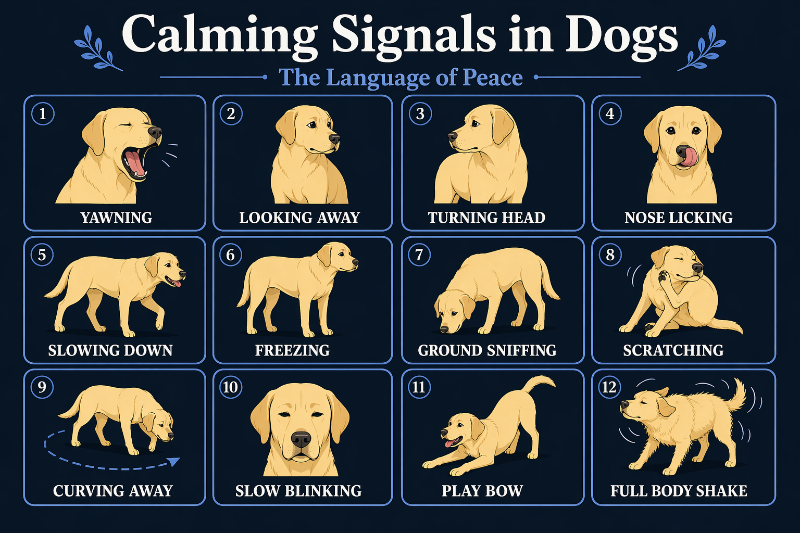
Calming signals are behaviors dogs use to reduce tension — in themselves, other dogs, or humans. Recognizing them helps you notice when a dog feels uncomfortable and needs more space.
- 🔸Yawning — often a sign of stress or an attempt to release tension, not always tiredness
- 🔸Looking away — avoiding conflict and trying to calm the situation
- 🔸Turning the head or body — the dog shows it wants to avoid confrontation and needs space
- 🔸Lip licking — quick tongue flicks may indicate stress or uncertainty
- 🔸Slowing down — the dog tries to calm itself or another dog
- 🔸Stopping — a pause to reduce tension in a social situation
- 🔸Sniffing the ground — distraction and avoidance of pressure
- 🔸Scratching or self-grooming — displacement behavior that helps reduce stress
- 🔸Approaching in an arc — a natural, polite way to avoid confrontation
- 🔸Slow blinking — a signal of calmness and no threat
- 🔸Play bow — an invitation to interact without tension
- 🔸Shaking off — releasing stress after a tense moment
You can also use some of these signals when interacting with your dog. Turning your body sideways, blinking slowly, avoiding leaning over the dog, and giving space often work better than forcing interaction.
Why Context Is Everything
The biggest mistake is judging a dog by a single signal. A tail between the legs may indicate fear, but for some dogs a low tail position is natural. An exposed belly may mean trust, but it can also be a request to stop interaction. Wide eyes may signal stress, but in some breeds they are more visible due to anatomy.
Always ask yourself three questions: what is the whole body doing, what is happening in the environment, and what happened just before?
How to Practice Observation?
The best exercise is quiet observation without interrupting the dog. Sit nearby, don’t call or touch the dog, and for a few minutes observe how its body changes: eyes, mouth, tail, ears, muscle tension, and breathing.
It’s also helpful to observe dogs at a distance during walks. Watch how they greet each other, when they slow down, when they move in an arc, when they look away, and when they need more space.
Over time, you’ll start noticing subtle changes in your own dog much faster. Every dog is an individual, so the better you know yours, the easier it becomes to understand what it’s really trying to say.